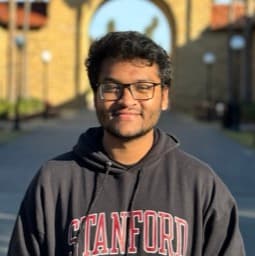
Sazzad Islam
Founding AI Engineer at Delve
Work in progress until August 12, 2026. I like setting deadlines, and the Perseids peaking under a new moon seemed more fitting than a random date. Sagan would approve.
[+]
Work in progress until August 12, 2026. I like setting deadlines, and the Perseids peaking under a new moon seemed more fitting than a random date. Sagan would approve.
[+]Every August, Earth passes through the debris trail of comet 109P/Swift-Tuttle. Tiny particles—most the size of a grain of sand to a pea—hit our atmosphere at 59 km/s (37 miles per second) and burn up as streaks of light. That's the Perseids, one of the best meteor showers of the year.
The catch: most years, moonlight washes out the faint ones. You might see 10-20 per hour instead of the full show.
But August 12, 2026 is different. The moon will be 0% illuminated—a new moon, completely dark. Under these ideal conditions, you can realistically expect 50-90 meteors per hour, including the fast, faint ones that usually hide in the moonlight. Some leave “persistent trains”—glowing trails of ionized gas that can linger for seconds after the meteor vanishes.
I needed a deadline, and “the night the sky puts on its best show in years” felt more meaningful than “Q3 2026.”
If you want to watch:
- Best time: after midnight until dawn, August 12-13
- Look northeast toward Perseus (but meteors appear all over the sky)
- Get away from city lights—dark skies matter as much as the new moon
- Give your eyes 20-30 minutes to adapt (no phone screens)
Bay Area spots:
- Mt. Tamalpais — Often above the fog layer. Check Clear Dark Sky forecast first.
- Lake Sonoma (Rockpile Road) — Darkest site in Sonoma County. Call ranger if arriving after dark: 707-431-4533.
- Mt. Hamilton / Lick Observatory — Best dark sky access in South Bay.
- Henry Coe State Park — 80,000 acres of dark sky, south of San Jose.
About
I'm the Founding AI Engineer at Delve, leading all AI initiatives. Our team recently built Computer Use Agents, Deep Research Agents, and a compliance-specific Copilot. Before Delve, I studied at Stanford, where I worked on education, robotics, and post-training foundation models—advised by Dorsa Sadigh, Chris Piech, and Sebastian Thrun—and collaborated on projects and papers with Chelsea Finn and Chris Manning.
I love the craft of problem solving. I grew up admiring Bell Labs[1]Invented the transistor, laser, Unix, C. Discovered evidence of the Big Bang.Small teams, extraordinary impact. and Skunk Works[2]XP-80 in 143 days. SR-71 Blackbird at Mach 3.2. Kelly Johnson's teams were 10-25% of normal size.Minimal bureaucracy, maximum autonomy. as a model: small, high-trust teams of exceptional problem solvers taking on hard problems and actually delivering. That's the kind of group I'm trying to build around me and be part of. To me, elite problem-solving is a domain-agnostic meta-capability. And the idea of applying that ability to meaningful work across humanity is genuinely exciting.
It's also a great optimization loop. The more you solve, the more you notice gaps in your thinking, the more you refine your approach, and the better you get.[3]“This very fact is proof that my spirit is altered into something better—that it can see its own faults, of which it was previously ignorant.”— Seneca, Letter 6 A lot of this started when I first read Cosmos in 4th grade.[4]“We make our world significant by the courage of our questions and the depth of our answers.”— Carl Sagan, Cosmos
That same arc is also why mentoring matters so much to me. I've been really fortunate to have great mentors and advisors throughout my life. I am who I am because a lot of wonderful people chose (and still choose) to help me, generously, consistently, and without expecting anything back, and push me to keep growing.[3]“The way is long if one follows precepts, but short and helpful if one follows patterns.”— Seneca, Letter 6 One of my goals is to pay that forward through mentoring and teaching, and spreading that same energy to others, because I genuinely believe, and the evidence supports,[5]Bloom's Two Sigma: tutored students performed better than 98% of classroom students.— Bloom, 1984 that mentoring is one of the most powerful ways to change the trajectory of an individual's life.[3]“No good thing is pleasant to possess, without friends to share it.”— Seneca, Letter 6
I love playing and watching football (huge Barca fan, Iniesta is my favorite), building PCs (I have at least one GPU from every NVIDIA architecture since Maxwell), playing around with speakers as an audiophile (preferred brands in different categories: JBL, GoldenEar, KEF, Bang & Olufsen), solving random puzzles, math, and algo problems (Advent of Code, Jane Street, IMO, IOI), working on DIY hardware projects, and driving—especially on mountain roads.
Research & Publications
My research focuses on AI systems, multi-agent learning, and practical machine learning applications. You can find my publications on Google Scholar.
Notes
A lot of these ideas were shaped by things I've read over the years. Expanding on some of the references and why they connect:
[1] Bell Labs[+]
It's actually incredible how an incredibly big chunk of modern technologies came out of this lab. The transistor (1947), the laser (theoretical foundations 1958, first working device 1960), Unix and C (1969), and the theoretical foundations for the digital age. The cosmic microwave background radiation—evidence of the Big Bang.
Some of my favorite scientists from Bell Labs:
- Claude Shannon — Founded information theory. Juggled four balls on a unicycle through Bell Labs and built shoes to walk on water. Read profile →
- Ken Thompson — Co-created UNIX. Built Belle, the first chess master computer. UNIX started because he wanted to port a video game to an old PDP-7. Oral history →
- Dennis Ritchie — Created C. So modest people would explain C to him at conferences without realizing he invented it. Kernighan's tribute →
- Richard Hamming — Invented error-correcting codes. Got banned from lunch tables for asking “What important problems are YOU working on?” “You and Your Research” →
- John Bardeen — Co-invented the transistor. Also developed the theory of superconductivity. Played water polo at Wisconsin. Profile →
- Mohamed Atalla — Enabled practical MOSFETs via silicon surface passivation. Bell Labs overlooked his work, so he quit and founded HP Labs. Then invented the Atalla Box for ATM security. Profile →
- Dawon Kahng — Co-invented the MOSFET. Got his PhD in 1959, co-invented MOSFET the same year, then invented flash memory in 1967. MOS history →
- Yann LeCun — Pioneered CNNs. Builds model airplanes and plays jazz. Called Elon Musk “nuts” for saying AI should be regulated. Profile →
[2] Skunk Works[+]
Skunk Works is the other half of the proof that small, elite teams can outperform traditional organizations by orders of magnitude.
Kelly Johnson's team built America's first jet fighter (XP-80) in 143 days—seven days ahead of schedule. They created the U-2 spy plane in 9 months and the SR-71 Blackbird, still the fastest manned aircraft ever at Mach 3.2. His philosophy: teams 10-25% of normal size, minimal bureaucracy, direct customer contact. Projects often started on a handshake, with contracts arriving months later.
[3] Seneca, Epistulae Morales ad Lucilium, Letter 6[+]
Letter 6 (“On Sharing Knowledge”) has three ideas that I find really meaningful: that recognizing your flaws is the first sign of growth, that watching how someone lives teaches more than their words ever could, and that wisdom kept to yourself isn't really wisdom at all.
“This very fact is proof that my spirit is altered into something better—that it can see its own faults, of which it was previously ignorant.”
“The way is long if one follows precepts, but short and helpful if one follows patterns.”
“No good thing is pleasant to possess, without friends to share it.”
[4] Carl Sagan, Cosmos (1980)[+]
Reading Cosmos in 4th grade changed how I imagined everything around me. I grew up in a small village in Bangladesh, and the book reshaped how I thought about the world. Unrelated, but it was the entry point to my love for quantitative topics. Some quotes I love:
“We make our world significant by the courage of our questions and the depth of our answers.”
“We are a way for the universe to know itself.”
[5] Bloom's Two Sigma Problem (1984)[+]
Bloom's 1984 study found that one-to-one tutoring improved students by two standard deviations—the average tutored student beat 98% of classroom students.
Bloom's “problem” was scaling this. For me, it's proof that mentoring works. The impact of one-on-one guidance on someone's life is huge.